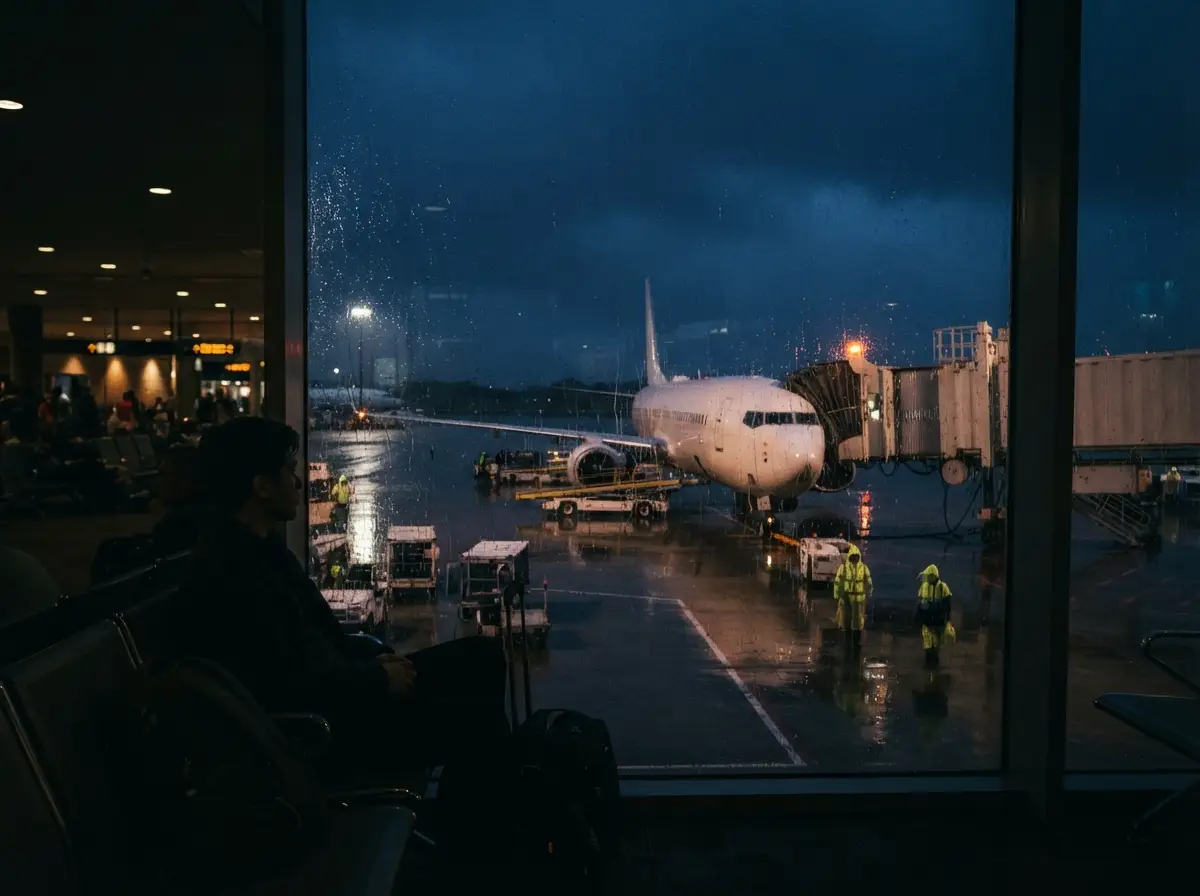
“Weather” is the reason airlines give most often when refusing compensation, partly because passengers rarely question it. Sometimes it is true and the refusal is correct. The law asks for more than the word, though, and the parts of your rights that do not depend on the cause stay in place.
When weather counts as extraordinary
Recital 14 of Regulation 261/2004 lists “meteorological conditions incompatible with the operation of the flight concerned” among the events that may be extraordinary circumstances. Two phrases matter.
Incompatible with the operation. Rain, wind or cold that an airline flies through every week is not enough. The conditions must have made the flight unsafe or impossible:
- An airport closed by snow.
- A storm beyond the aircraft’s limits.
- Fog below landing minima.
- A volcanic ash cloud closing airspace.
The flight concerned. The weather has to affect your flight.
Recital 15 adds a second route: an air traffic management decision on a particular day that causes a long delay or cancellation. Weather often reaches flights this way, through reduced capacity ordered by air traffic control.
| Situation | Likely outcome |
|---|---|
| Airport closed or runway unusable because of snow, storm or flooding | Extraordinary |
| Air traffic control restrictions imposed because of weather | Extraordinary (recital 15) |
| Lightning strike requiring a mandatory safety inspection | Extraordinary (CJEU, C-399/24) |
| Winter conditions the airport and airline should be equipped for, such as routine de-icing | Open to challenge: the airline must show it could not have avoided the delay |
| Your flight cancelled while other airlines flew the same route at the same time | Open to challenge |
| Weather affected a different flight earlier in the day | Only with a direct causal link (CJEU, TAP, C-74/19) |
The “all reasonable measures” test
Watch out
An extraordinary event does not release the airline by itself.
Under Art. 5(3) the airline must also prove that the cancellation or delay could not have been avoided even if all reasonable measures had been taken. The Court of Justice has explained what that means:
- The airline must have used all the staff, equipment and financial resources at its disposal, short of intolerable sacrifices for its business (CJEU, Wallentin-Hermann, C-549/07).
- When planning its flights, it must build in a reserve of time so that it can operate the flight once the extraordinary event ends (CJEU, Eglītis, C-294/10).
- It must re-route passengers by the earliest available option, including direct or indirect flights on other airlines. Putting you on its own next flight a day later is not enough if something earlier existed (CJEU, TAP, C-74/19).
So a storm that closed the airport from 14:00 to 16:00 does not automatically excuse a flight that finally left at 23:00, or one that was cancelled although the airport had reopened.
Knock-on delays from earlier flights
Aircraft fly several rotations a day. A common refusal says the aircraft was late because of weather somewhere else that morning.
In TAP (C-74/19) the Court of Justice accepted that an airline can rely on an extraordinary circumstance that affected a previous flight operated by the same aircraft.
The condition is a direct causal link between that event and the delay or cancellation of your flight, which the airline must prove and the national court must check.
The more rotations and hours between the weather and your flight, the harder that is to show, because the airline had time to react: swap aircraft, use a standby crew, absorb the delay in turnaround time.
Tip
Ask the airline which flight was affected, at which airport, at what time, and what it did afterwards to recover the schedule.
What the airline owes in any weather
These rights apply whatever the cause:
- Care. Meals and drinks in reasonable relation to the wait, two phone calls or emails, hotel accommodation and transfers when an overnight stay is needed (Art. 9).
- In McDonagh (C-12/11) a passenger was stranded for a week when volcanic ash closed European airspace.
- The Court held that the airline owed care for the whole period, with no time or money limit in the regulation, and that a passenger left without it can recover reasonable expenses.
- Refund or re-routing. For a cancellation, or a delay of five hours or more, you choose (Art. 8).
- Information. A written notice of your rights (Art. 14).
Details are in flight delay and flight cancellation.
What to do
- At the airport, ask for meal vouchers and, if you are stuck overnight, a hotel. If refused, keep receipts and stay within reasonable prices.
- Take a photo of the departures board. It shows which flights left.
- Ask the airline in writing for the precise reason and the evidence.
- If the answer is vague, or the weather was on an earlier rotation, send a claim using the claim letter. The burden of proof is on the airline, not on you.
- If it refuses again, see how to claim.
Other regimes
- UK: the same test applies under UK261.
- Brazil: material assistance (food after two hours, accommodation after four when an overnight stay is needed) and the choice of re-accommodation or refund apply whatever the cause, including weather (ANAC Resolution 400).
- United States: weather gives a right to a refund if the flight is cancelled or significantly delayed and you do not travel, and nothing more under federal rules (US DOT rules).
From 23 October 2027
Regulation (EU) 2026/2202 adds an annex of extraordinary circumstances that includes weather conditions, and weather damage to the aircraft, incompatible with the safe operation of the flight. It requires a direct causal link, to be proved by the airline.
It also allows airlines to limit hotel accommodation to three nights when the disruption is caused by extraordinary circumstances.
Good to know
Until it applies, there is no such limit.